Poka-Yoke: Error-Proofing GCC Processes with Lean Six Sigma
August 28, 2026
Like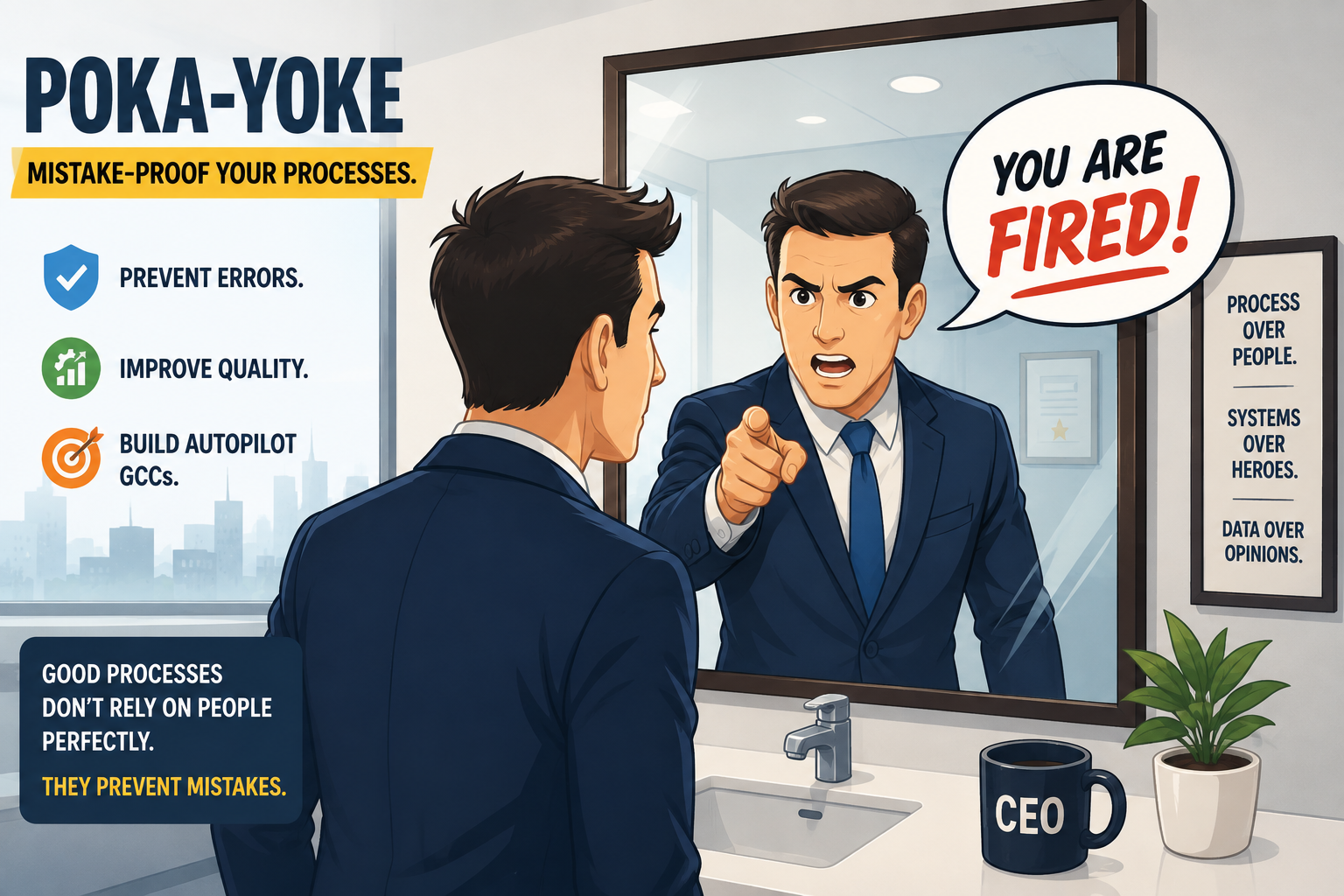
Downloadable templates
Learn how Poka-Yoke error-proofing prevents mistakes in Global Capability Centers by designing processes that catch errors before they become defects.
What Is Poka-Yoke?
Poka-Yoke is a Lean Six Sigma technique used to prevent mistakes or detect them before they become defects.
The Japanese term Poka-Yoke roughly translates to “mistake-proofing” or “error-proofing.”
The fundamental principle is simple:
Don't depend entirely on people to prevent mistakes. Design the process so mistakes are prevented, made difficult, or detected immediately.
In a traditional process, organizations often respond to errors by adding more reviews, more approvals, more checklists, or more people.
Poka-Yoke takes a different approach.
Instead of asking:
“Who made the mistake?”
it asks:
“Why did the process allow the mistake to happen?”
That shift is at the heart of process improvement.
Why Poka-Yoke Matters in a GCC
Global Capability Centers (GCCs) operate thousands of transactions, requests, tickets, approvals, deployments, reconciliations, and handoffs every day.
Many of these processes depend on people doing repetitive activities correctly.
That creates a predictable problem:
More volume → More opportunities for human error.
For example:
- An employee enters the wrong cost center.
- A service request is submitted without mandatory information.
- A software access request goes to the wrong approver.
- An invoice is processed without a purchase order.
- A production change is deployed with an incorrect configuration.
- A critical escalation is missed because nobody noticed an SLA breach.
Organizations often respond by adding another control:
“Let's have someone check it.”
That can work temporarily.
But as the GCC grows, the control itself becomes another process to manage.
Poka-Yoke asks a better question:
Can we design the process so the error cannot happen in the first place?
The Basic Idea Behind Poka-Yoke
A simple way to understand Poka-Yoke is:
Prevent → Detect → Correct
1. Prevent
Stop the mistake from happening.
Example:
Instead of allowing an employee to manually type a department name, provide a predefined dropdown list.
The user cannot enter an invalid department.
2. Detect
If prevention isn't possible, identify the mistake immediately.
Example:
A system detects that an invoice does not have a matching purchase order and automatically flags it.
The error doesn't travel downstream.
3. Correct
Make it easy to fix the problem before it becomes a larger defect.
Example:
A service request is automatically returned to the requester with the missing information highlighted.
The process provides the correction path instead of relying on someone to discover the problem later.
Poka-Yoke vs Traditional Quality Control
This is where Poka-Yoke becomes particularly powerful.
Traditional quality control often works like this:
Process → Output → Inspection → Defect Found → Rework
Poka-Yoke aims for:
Process → Error Prevented → Correct Output
The difference is important.
Inspection asks:
“Did we make a mistake?”
Poka-Yoke asks:
“How can we design the process so we don't make the mistake?”
Inspection is still valuable.
But prevention is generally more powerful than detection after the fact.
Simple Examples of Poka-Yoke
Poka-Yoke doesn't have to involve sophisticated technology.
Some of the best examples are incredibly simple.
Example 1: Mandatory Fields
Suppose an IT service request requires:
- Employee ID
- Department
- Manager
- Application
- Business justification
Without Poka-Yoke, the request could be submitted with missing information.
With Poka-Yoke:
The system doesn't allow submission until required information is provided.
The process prevents an incomplete request from entering the workflow.
Example 2: Dropdown Lists
Instead of allowing:
Department: __________
use:
Department:
[Finance ▼]
This eliminates spelling variations, invalid values, and inconsistent naming.
A small interface decision can eliminate an entire category of downstream errors.
Example 3: Duplicate Detection
Imagine a GCC receives thousands of support requests.
Two employees might unknowingly create requests for the same issue.
A Poka-Yoke control can detect:
- Same employee
- Same application
- Similar issue
- Similar timestamp
and warn:
“A similar request already exists.”
The system prevents unnecessary duplicate work.
Poka-Yoke in GCC IT Operations
IT operations are particularly suitable for mistake-proofing because many processes are structured and repetitive.
Consider software access provisioning.
Traditional process
Employee joins → Manager emails IT → IT checks request → IT creates account → IT assigns permissions → Employee reports missing access → IT investigates
There are multiple opportunities for error.
Poka-Yoke approach
Employee joins → HR system creates employee record → Role determines access profile → System validates required attributes → Access is provisioned → Exceptions are routed to IT
Now the system handles the predictable path.
Humans deal primarily with exceptions.
That is an important step toward an autonomous operating model.
Poka-Yoke in Finance Operations
Finance processes also contain many opportunities for mistake-proofing.
For example, consider invoice processing.
Potential errors
- Missing PO
- Incorrect vendor
- Incorrect amount
- Duplicate invoice
- Wrong cost center
- Missing approval
Instead of relying exclusively on manual checking, controls can be embedded into the workflow.
For example:
Invoice submitted
↓
Vendor validated
↓
PO matched
↓
Amount validated
↓
Duplicate check
↓
Approval verified
↓
Payment processing
If any condition fails, the process automatically stops or routes the transaction to an exception queue.
That's Poka-Yoke.
Poka-Yoke in HR Operations
Consider employee onboarding.
A traditional onboarding process may involve:
HR → Manager → IT → Facilities → Security → Payroll
Every handoff creates an opportunity for missing information or delay.
Poka-Yoke can introduce controls such as:
- Mandatory employee information
- Standardized job roles
- Predefined access profiles
- Automated approval routing
- Required compliance acknowledgements
- Automated deadline alerts
- Validation before account creation
The objective isn't simply to automate onboarding.
The objective is to prevent predictable onboarding failures.
Poka-Yoke in Cybersecurity
Poka-Yoke can also be used as a security control.
For example:
A developer attempts to deploy a production change.
Instead of relying on someone to remember every security requirement, the pipeline can automatically verify:
- Code review completed
- Required tests passed
- Security scan completed
- Required approvals obtained
- Deployment target is correct
If a requirement isn't satisfied:
Deployment is blocked.
This is mistake-proofing through technology.
The system doesn't ask:
“Did someone remember to check?”
It enforces the rule.
The Three Levels of Poka-Yoke
Poka-Yoke can generally be implemented at different levels of strength.
Level 1: Warning
The system identifies a potential mistake.
Example:
⚠️ “This request appears to contain an invalid cost center.”
The user can still continue.
Level 2: Detection
The system detects the mistake and prevents the transaction from progressing.
Example:
❌ “Request cannot be submitted because the cost center is invalid.”
The error is stopped before entering the next stage.
Level 3: Prevention
The process is designed so the mistake cannot realistically occur.
Example:
Instead of allowing manual cost-center entry, the system automatically retrieves the valid cost center from the employee's organizational profile.
There is no opportunity to enter an invalid value.
How to Implement Poka-Yoke
A practical implementation approach can be broken into seven steps.
Step 1: Identify the Process
Start with a process that has:
- High transaction volume
- Frequent errors
- High rework
- Repeated escalations
- SLA breaches
- Customer complaints
- High dependency on manual checks
Don't start by asking:
“Where can we use Poka-Yoke?”
Start by asking:
“Where are mistakes repeatedly entering our process?”
Step 2: Map the Process
Use Value Stream Mapping or a process flow to understand how work moves through the organization.
Map:
Input → Activity → Decision → Handoff → Output
Look for points where information can become:
- Missing
- Incorrect
- Delayed
- Duplicated
- Misinterpreted
These are potential Poka-Yoke opportunities.
Step 3: Identify Failure Modes
This is where FMEA — Failure Mode and Effects Analysis — becomes useful.
For each process step, ask:
What could go wrong?
Then evaluate:
- Severity
- Occurrence
- Detection
For example:
| Process Step | Failure | Impact | Potential Control |
|---|---|---|---|
| Submit request | Missing information | Processing delay | Mandatory fields |
| Select department | Invalid value | Incorrect routing | Dropdown |
| Approve request | Wrong approver | Compliance risk | Role-based routing |
| Create account | Wrong access | Security risk | Access template |
| Close ticket | Incomplete resolution | Reopening | Closure validation |
This creates a structured path from failure → control.
Step 4: Determine the Root Cause
Don't immediately automate the visible problem.
Find out why the problem exists.
Use techniques such as:
5 Whys
Ask:
Why did the request fail?
Then keep asking why until you reach the underlying process problem.
For example:
Why was access delayed?
Because IT received incomplete information.
Why was the information incomplete?
Because the request form didn't require it.
Why didn't the form require it?
Because the original process assumed the requester knew what information IT needed.
Now the solution becomes obvious:
Make the required information mandatory.
That's a much better solution than telling IT employees to “be more careful.”
Step 5: Design the Mistake-Proofing Control
Now decide how the process should prevent or detect the error.
Possible mechanisms include:
- Mandatory fields
- Validation rules
- Dropdown menus
- Automated calculations
- Role-based permissions
- Approval gates
- Duplicate detection
- Threshold alerts
- Workflow rules
- API validation
- Automated reconciliation
- Configuration templates
- Automated testing
- System-enforced policies
The best solution is usually the simplest one that reliably prevents the error.
Step 6: Automate Where Appropriate
Once the process is standardized, automation can take it further.
For example:
Before
Employee → Form → HR → Email → IT → Manual verification → Provisioning
After
Employee → Validated form → Automated workflow → Access provisioning → Exception queue
Automation handles the standard path.
Humans handle exceptions.
This creates a much more scalable operating model.
Step 7: Create a Control Plan
Poka-Yoke should not be implemented and forgotten.
Define:
- What is being controlled?
- What is the acceptable threshold?
- Who owns the control?
- What happens when it fails?
- How is performance measured?
- How frequently is the control reviewed?
Useful metrics include:
First-Time-Right %
How many transactions are completed correctly without rework?
Error Rate
How many transactions contain errors?
Rework Rate
How much work is repeated because of process defects?
Exception Rate
How often does the automated process require human intervention?
SLA Breach Rate
How frequently does the process miss its committed SLA?
Escalation Rate
How often does the process require management intervention?
Poka-Yoke and the GCC Autopilot Model
Poka-Yoke becomes especially powerful when combined with other Lean Six Sigma techniques.
A mature GCC can follow this sequence:
Value Stream Mapping
↓
Identify waste and bottlenecks
↓
FMEA
↓
Identify potential failure modes
↓
Root Cause Analysis
↓
Understand why failures occur
↓
Poka-Yoke
↓
Prevent predictable mistakes
↓
Automation
↓
Execute standardized work automatically
↓
Control Plan
↓
Monitor performance
↓
Continuous Improvement
↓
Improve the process continuously
This is how a GCC gradually moves from people-dependent operations toward process-driven operations.
The Most Important Principle
Poka-Yoke is not about blaming employees.
In fact, it is almost the opposite.
When the same mistake happens repeatedly, the first question should not be:
“Why aren't people paying attention?”
The better question is:
“Why does our process make this mistake possible?”
If ten people independently make the same mistake, you probably don't have a people problem.
You have a process design problem.
Poka-Yoke vs Automation
These concepts are often confused.
They are related, but they are not the same.
Automation
“Let the system perform the task.”
Poka-Yoke
“Make the task difficult or impossible to perform incorrectly.”
The strongest GCC operating models combine both.
For example:
Manual + Error-Prone
Employee enters data manually.
↓
Poka-Yoke
System validates the data.
↓
Automation
System processes the transaction.
↓
Control
Dashboard monitors exceptions.
The result is not merely automation.
It is controlled automation.
A Simple Rule for GCC Leaders
When evaluating any process, ask these five questions:
1. Where can the process fail?
Identify the failure points.
2. Why can it fail?
Find the root cause.
3. Can we prevent the failure?
If yes, introduce Poka-Yoke.
4. If we cannot prevent it, can we detect it immediately?
Build a detection mechanism.
5. Can the standardized process be automated?
If yes, automate the predictable path.
This creates a powerful operating philosophy:
Prevent what you can. Detect what you can't prevent. Automate what you can standardize. Escalate only what requires human judgment.
Final Takeaway
Poka-Yoke is one of the simplest ideas in Lean Six Sigma, but it can have a significant impact on GCC operations.
It changes the focus from:
“Train people to avoid mistakes.”
to:
“Design processes that prevent mistakes.”
And that distinction becomes increasingly important as GCCs scale.
Because a process that works only when everyone remembers every rule is not truly scalable.
A scalable process has controls built into it.
A highly mature process goes one step further:
The system prevents predictable mistakes, automatically handles standard work, detects exceptions, and brings humans into the loop only when judgment is required.
That's the real power of Poka-Yoke.
Not fewer people.
Fewer preventable mistakes.
Less rework.
Fewer escalations.
And a GCC that can scale without scaling operational complexity at the same rate.
Comments
Be the first to comment on this post.
Sign in to leave a comment.