SIPOC Map for Standing Up a New GCC Function
August 30, 2026
Like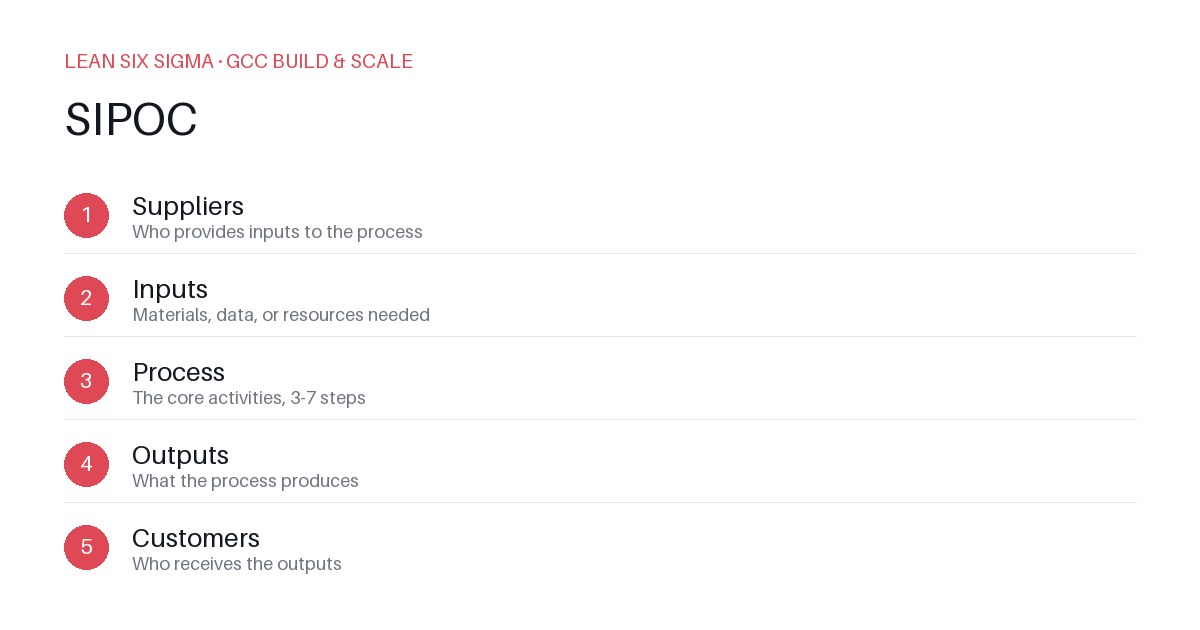
Downloadable templates
Use a SIPOC map to clarify inputs, processes, outputs, and customer needs before launching a new GCC capability.
Define the Scope and Stakeholders
Start by naming the GCC function. Examples: end-to-end data governance, automated testing framework, or cloud cost optimization. Identify the primary customer — the business unit or product team that will consume the output. Document their explicit and implicit requirements. Avoid vague goals like "improve quality." Instead, specify measurable outcomes: reduce defect escape rate to under 2%, or cut cloud spend by 15% in six months.
Map the Suppliers and Inputs
List every source of requirements, data, tools, and approvals. For a data governance GCC, suppliers might include product owners, compliance officers, IT infrastructure, and legacy system teams. Capture the format and frequency of inputs. Are requirements delivered via Jira tickets, email, or ad-hoc meetings? Are there SLAs for input delivery? Document any dependencies that could delay the GCC function.
Chart the Core Processes
Break the GCC function into discrete steps. For example, a testing framework GCC might include: requirement analysis, test design, automation script development, CI/CD integration, and performance monitoring. Assign owners to each process step. Note the tools or platforms used. Highlight any handoffs between teams. Use swimlanes if multiple teams contribute. Keep descriptions action-oriented: "Define test cases based on user stories" rather than "Handle testing." Avoid combining unrelated steps.
Clarify Outputs and Customer Needs
Define what the GCC function delivers. Outputs should be tangible: a validated test suite, a compliance audit report, or a cost optimization dashboard. Specify quality criteria: accuracy, timeliness, and usability. Link each output back to the customer’s stated needs. For instance, if the customer requires faster release cycles, ensure the output includes metrics on cycle time reduction. Document how outputs are measured and validated.
Validate and Iterate
Review the SIPOC map with stakeholders. Ask: Are all critical inputs captured? Are process handoffs clear? Do outputs meet customer expectations? Adjust based on feedback. Update the map as the GCC function evolves. Use this document as a living reference for onboarding, training, and process improvement. Revisit quarterly to ensure alignment with business goals. Keep it concise — a one-page SIPOC map is more useful than a ten-page manual. Share it widely to build shared understanding across the GCC and its customers.
Comments
Be the first to comment on this post.
Sign in to leave a comment.