Using DMAIC to Fix GCC Onboarding Delays
October 7, 2026
Like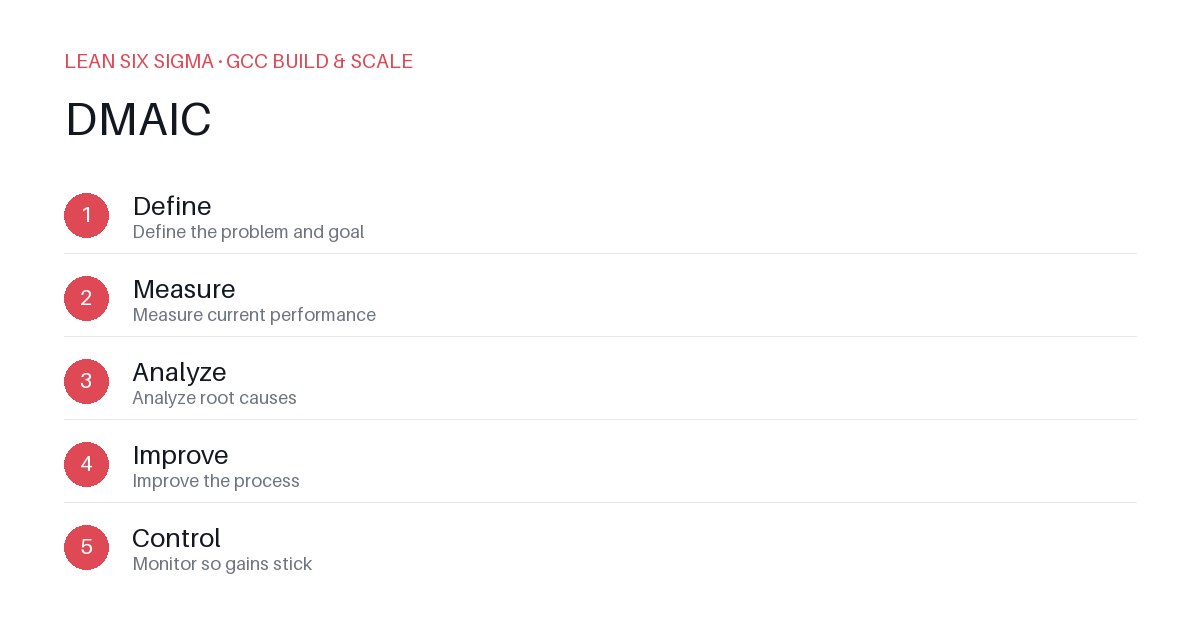
Downloadable templates
Cut onboarding time in half by mapping bottlenecks with DMAIC and automating repetitive setup steps.
Define the Real Problem
Onboarding delays in Global Capability Centers (GCCs) rarely stem from a lack of talent. They come from fragmented handoffs, duplicated paperwork, and unclear ownership. Start by collecting onboarding data for the past quarter: track time from offer acceptance to first productive task. Segment delays by region, role, and department. You’ll likely find hotspots—IT provisioning, security clearance, or manager readiness—account for 70% of slippage. Define the problem precisely: “Reduce new hire onboarding time from 28 days to 14 days within 90 days.”
Measure Current Performance
Map the current onboarding process end-to-end. Use a value stream map to identify every handoff, approval, and wait state. Time each step. Document where work stalls: e.g., IT tickets sit for 48 hours, HR waits for manager confirmation, or training modules aren’t pre-loaded. Calculate the cycle time vs. lead time gap. Establish baseline metrics: average onboarding duration, % of hires starting on Day 1, and rework rate (tasks requiring correction after completion). This data becomes your control plan reference.
Analyze Root Causes
Run a 5-Whys analysis on the top three delay drivers. For example, if IT provisioning takes 5 days:
- Why? Ticket backlog.
- Why? Manual data entry from HRIS.
- Why? No integration between systems.
- Why? Legacy tooling.
- Why? No standardization across GCC regions.
Cross-reference with defect data. Are delays correlated with specific managers, regions, or role types? Use Pareto analysis to prioritize fixes that impact the most delays. Often, the root cause is process design, not people performance.
Improve with Lean Solutions
Design a streamlined onboarding workflow. Automate IT provisioning by integrating HRIS with IT service management tools. Implement a single source of truth for hire data. Create role-based onboarding checklists with clear SLAs for each step. Pilot the new process with one cohort. Train managers on their onboarding responsibilities. Use standard work to reduce variation. Implement error-proofing (poka-yoke) where possible—e.g., block system access until security clearance is complete.
Control and Sustain
Monitor onboarding metrics weekly. Use control charts to track process stability. Assign an onboarding champion to own continuous improvement. Conduct monthly retrospectives to capture lessons learned. Update the process map as roles or regions evolve. Tie onboarding performance to GCC maturity metrics. Celebrate wins publicly to reinforce adoption. The goal isn’t just faster onboarding—it’s a repeatable, scalable system that adapts as the GCC grows.
Comments
Be the first to comment on this post.
Sign in to leave a comment.