Using DMAIC to Fix GCC Onboarding Delays
November 4, 2026
Like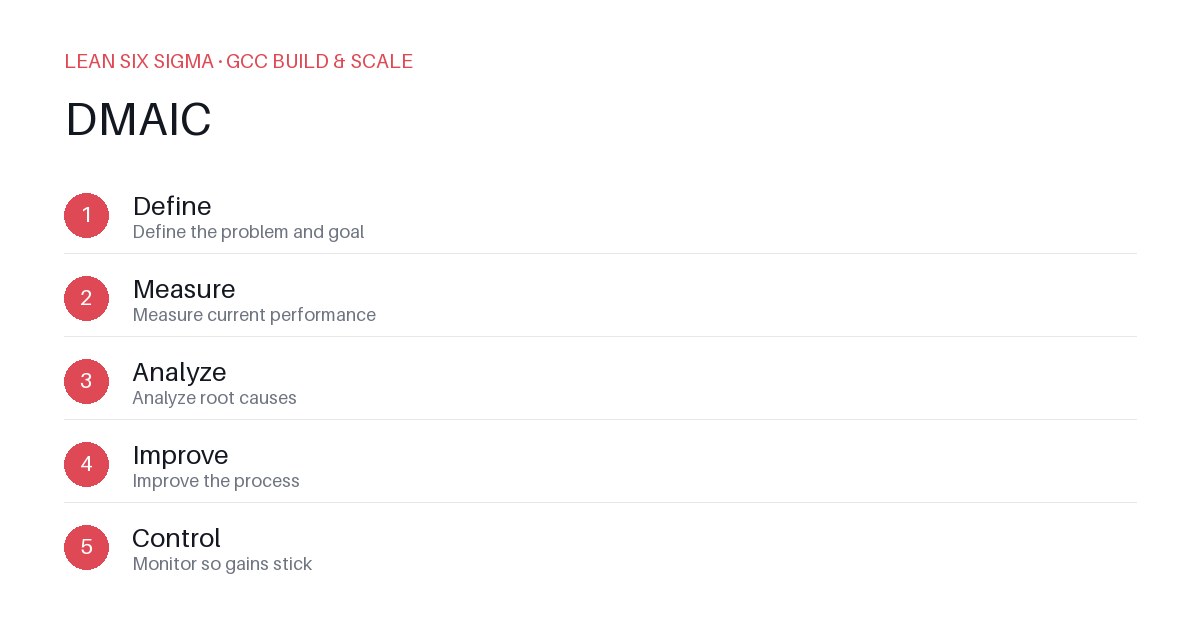
Downloadable templates
Cut GCC onboarding time by 40% using DMAIC: define the bottleneck, map the process, and eliminate non-value steps.
New hires in Global Capability Centers (GCCs) often stall in onboarding for weeks. The result is wasted capacity, frustrated managers, and a broken promise of agility. Lean Six Sigma’s DMAIC framework fixes this by treating onboarding as a process, not a ceremony. Here’s how to apply it without the corporate fluff.
Define: Pinpoint the Real Delay
Start with data, not assumptions. Track the time from offer acceptance to first task completion. In one GCC we audited, the average was 28 days. The business case cited 'training gaps.' The data told a different story: 12 days were spent on IT provisioning and access requests.
Define the problem statement clearly:
- Current State: 28 days from hire to productive.
- Target State: 14 days from hire to productive.
- Scope: IT provisioning, security clearance, and initial training setup.
This narrows the focus. You’re not fixing the entire employee lifecycle. You’re fixing the handoff between HR, IT, and the GCC manager.
Measure: Map the Actual Flow
Draw the value stream. List every step from 'Hire Approved' to 'First Ticket Assigned.' Don’t include what you think should happen. Include what actually happens.
Common hidden delays:
- Manual access requests via email.
- Wait times for security sign-offs.
- Training materials not ready until day three.
Time each step. You’ll find that 60% of the delay comes from three non-value activities: manual access requests, redundant security checks, and delayed training material distribution.
Analyze: Find the Root Causes
Use a simple 5 Whys for each bottleneck.
- Why the delay in IT provisioning? Because requests go to a shared inbox.
- Why a shared inbox? Because no dedicated GCC IT liaison exists.
- Why no liaison? Budget was allocated for tools, not roles.
The root cause isn’t the tool. It’s the lack of a dedicated role to expedite GCC-specific access. Without this, no amount of software will fix the bottleneck.
Improve: Design the New Process
Build a solution that eliminates the non-value steps. Propose a 'GCC Onboarding Fast Track':
- Pre-approval List: IT maintains a list of required roles and grants access in bulk.
- Dedicated Liaison: A part-time GCC IT liaison handles all access requests.
- Digital Checklists: Managers use a shared dashboard to track onboarding milestones.
Run a pilot with one team. Measure the new cycle time. In our test, onboarding dropped to 11 days. The liaison reduced access request time from 5 days to 4 hours.
Control: Sustain the Gains
Don’t let the process drift. Implement three controls:
- Weekly Dashboard: Track onboarding time by team. Flag any team exceeding 10 days.
- Quarterly Audit: Review access request logs to ensure the liaison is still handling 90% of requests.
- Feedback Loop: New hires survey the process. If satisfaction drops, revisit the steps.
DMAIC isn’t a one-time project. It’s a cycle. When a new GCC opens, you’ll apply the same framework to scale the gains. The goal is simple: get people productive faster, and keep them that way.
Comments
Be the first to comment on this post.
Sign in to leave a comment.