Control Plans for GCC Process Stability
October 24, 2026
Like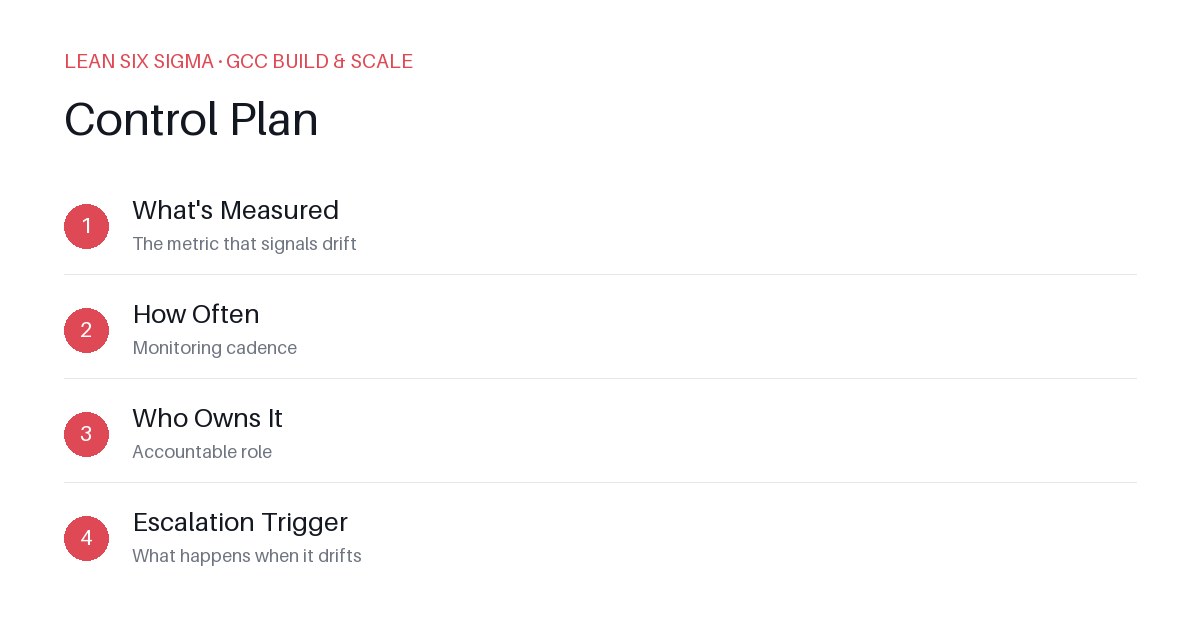
Downloadable templates
How to build control plans that lock in GCC gains and prevent process drift during scale-up.
Why GCCs Lose Control After the Pilot
You fix a process. Defect rates drop. The sponsor signs off. Six months later, the same errors return. Not because the team is lazy, but because the control plan was a slide deck, not a working document.
A control plan is the bridge between project closure and steady-state operation. Without it, GCCs revert to tribal knowledge and ad-hoc fixes. This post shows you how to build a control plan that actually works in a scaling environment.
What Goes Wrong in GCC Control Plans
Most GCC control plans fail for one of three reasons:
- Too generic: They describe the process, not the control. No metrics, no owners, no response times.
- Too static: They’re written once and never updated. When the process changes, the plan becomes fiction.
- Too top-down: The team doesn’t own it. They follow it until it breaks, then ignore it.
Build a Control Plan That Sticks
Start with the process that matters. Pick one high-impact workflow — e.g., requirements intake, defect triage, or release preparation. Map the steps, then identify where variation happens.
For each step, define:
- What is being controlled: The output or state (e.g., “All requirements have a priority label and owner assigned before development starts.”)
- How it is measured: The metric and frequency (e.g., “100% of requirements tagged within 24 hours of intake. Checked daily.”)
- Who is responsible: The role, not the person (e.g., “Process Owner: QA Lead.”)
- What happens when it fails: The response action and escalation path (e.g., “If <95% tagged, QA Lead escalates to GCC Manager within 2 hours.”)
Write this in a living document — Confluence, SharePoint, or even a shared spreadsheet. Make it easy to update.
Embed Controls into Daily Work
A control plan is useless if it sits in a drawer. Embed it into the team’s rhythm:
- Stand-ups: Start with control metrics. “How many requirements tagged today?”
- Reviews: Include control plan compliance in sprint reviews or monthly GCC reviews.
- Training: Use the control plan as a training tool for new hires. Show them what “good” looks like.
Monitor, Adapt, Repeat
Control plans aren’t set-and-forget. Review them monthly:
- Are the metrics still relevant? If the process changed, update the controls.
- Are the owners still accurate? Rotate responsibilities as needed.
- Are the response actions working? If escalation doesn’t fix the problem, change the action.
Treat the control plan as a living artifact. Update it when the process changes. Celebrate when it works. Fix it when it doesn’t.
Final Thought
Control plans are the difference between a GCC that scales and one that stalls. Build them with specificity, own them with the team, and update them with discipline. That’s how you keep stability as you grow.
Comments
Be the first to comment on this post.
Sign in to leave a comment.