SIPOC Map for Standing Up a New GCC Function
October 30, 2026
Like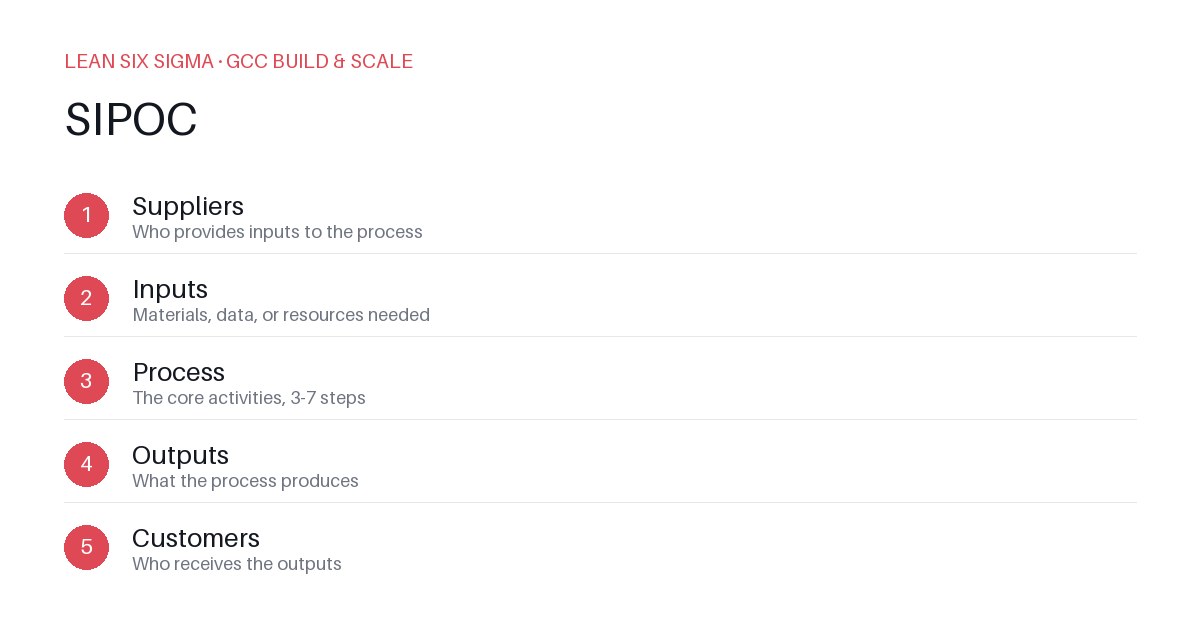
Downloadable templates
Map the SIPOC elements to avoid scope creep and ensure smooth handoff for your new GCC capability.
Start with the Customer, Not the Process
When you’re standing up a new GCC function—whether it’s AI/ML, data engineering, or cloud migration—the biggest mistake is defining the process before you define who benefits. Start by identifying the primary customers. These are usually the business units or product teams that consume the output. For example, if you’re building a predictive analytics function, the customer is likely the product development team or the marketing analytics group.
Suppliers Provide the Inputs
Next, map your suppliers. These are the entities or systems that provide the inputs to your new function. In our predictive analytics example, suppliers might include:
- Raw data pipelines from the data warehouse
- Historical performance metrics from CRM systems
- Domain expertise from subject matter experts
Documenting suppliers early prevents bottlenecks. If a supplier isn’t ready to provide clean, structured inputs, your GCC function will stall before it even launches.
The Process Must Be Specific
The process section is where many teams get stuck in vague descriptions like “analyze data” or “build models.” Instead, break the process into discrete, measurable steps:
- Data ingestion and validation
- Feature engineering
- Model training and validation
- Deployment to production
- Monitoring and retraining
Each step should have a clear owner, a defined output, and a success metric. Ambiguity here leads to rework and delayed time-to-value.
Outputs Deliver Value
Define the outputs that matter to your customers. For a predictive analytics function, outputs might include:
- A validated model with documented accuracy metrics
- A deployment package ready for production use
- A monitoring dashboard showing model drift
If the outputs don’t align with what the customers need, the function will struggle to gain adoption. Always tie outputs back to business outcomes.
Avoid Common Pitfalls
- Scope creep: Adding too many steps or suppliers early on. Keep the initial SIPOC map tight and iterate as needed.
- Ignoring feedback loops: Ensure there’s a mechanism for customers to provide feedback on outputs, which feeds back into the process for improvement.
- Underestimating supplier readiness: Verify that suppliers can meet the input requirements before finalizing the process steps.
Use the Map for Communication
A SIPOC map isn’t just a planning tool; it’s a communication device. Share it with stakeholders to align on expectations. When everyone understands who supplies what, how it’s processed, and what’s delivered, you reduce friction and accelerate the stand-up process.
Next Steps
Once your SIPOC map is complete, use it to draft a detailed project plan. Assign owners for each step, set timelines, and identify potential risks. Then, execute the stand-up process with clarity and focus.
Comments
Be the first to comment on this post.
Sign in to leave a comment.