A SIPOC Map for Standing Up a New GCC Function
September 5, 2026
Like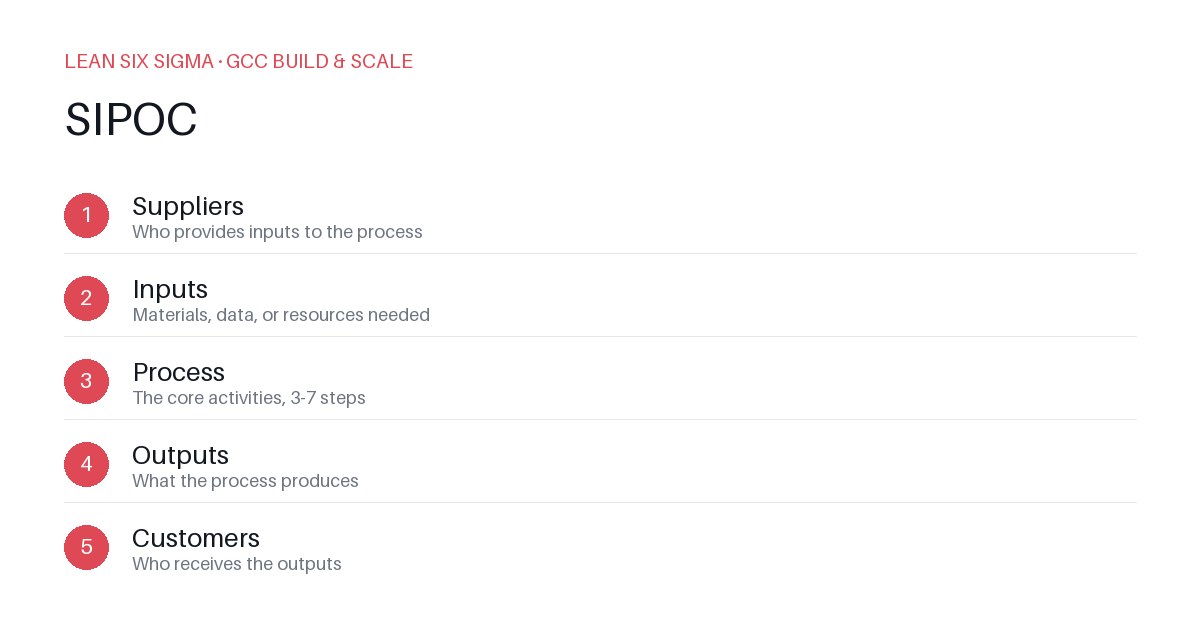
Downloadable templates
Map the flow from customer need to process output to eliminate gaps before building your new GCC function.
Define the Process Scope
You're launching a new GCC function—maybe AI model monitoring or supply chain analytics. Before hiring or buying tools, draw the SIPOC. It's not a nice-to-have; it's your blueprint. Start with what you know: the business problem and the end result. Everything else flows from there.
Identify Suppliers and Inputs
Who or what feeds into your new function? List them explicitly.
- Internal suppliers: IT infrastructure, data engineering, finance, HR.
- External suppliers: Cloud providers, software vendors, training partners.
- Inputs: Raw data, licenses, headcount, budget approvals.
Missing a supplier? Your process stalls. Example: You plan a data science GCC but forget the data governance team. Now your models train on dirty data. Fix this now.
Define the Process
Break the function into 5-7 steps. Keep it high-level but specific. Avoid jargon.
- Step 1: Requirements gathering
- Step 2: Tool selection and setup
- Step 3: Team onboarding
- Step 4: Pilot project execution
- Step 5: Scale and optimize
This isn't a project plan; it's the core workflow. If a step can't be measured, refine it.
Map Outputs and Customers
What does your function deliver? Who receives it?
- Outputs: Validated models, dashboards, reports, trained analysts.
- Customers: End users, product teams, executives.
Clarify acceptance criteria. A model isn't "done" until it meets accuracy thresholds and integration standards. Define this upfront.
Spot the Gaps
Look for handoff points. Where does work stop? Where does it restart? These are your risk zones.
- Example: Data engineering hands off clean data to ML ops. But no SLA exists. Now ML ops waits.
- Fix: Add a service level agreement and a single point of contact.
SIPOC reveals these leaks. Use it to negotiate resources and set expectations.
Validate with Stakeholders
Don't work in a vacuum. Walk the map with 3-5 people: a customer, a supplier, and a process owner.
Ask:
- "Where does this break?"
- "What's missing?"
- "What would slow this down?"
Document their feedback. Adjust the map. Repeat until it holds up.
Turn the Map into Action
Once validated, convert the SIPOC into a 30-60-90 day plan.
- 30 days: Secure suppliers, finalize inputs.
- 60 days: Execute pilot steps.
- 90 days: Measure outputs, refine process.
SIPOC isn't static. Revisit it quarterly. As your GCC matures, so does the map. Start with this, and you'll avoid the chaos of building without a blueprint.
Comments
Be the first to comment on this post.
Sign in to leave a comment.